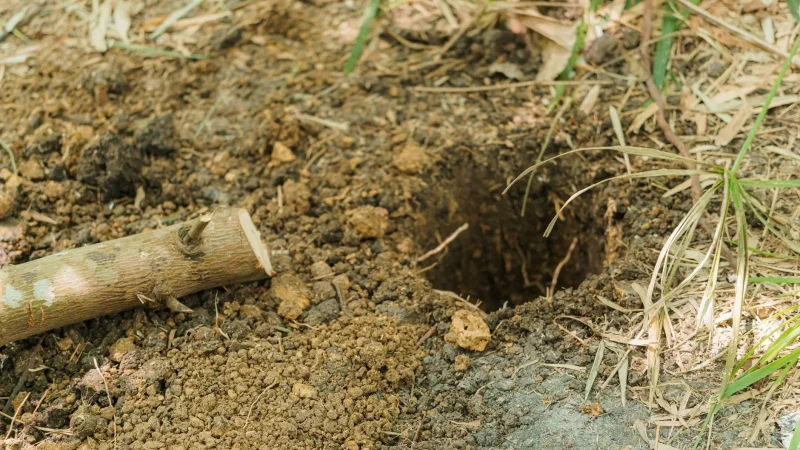
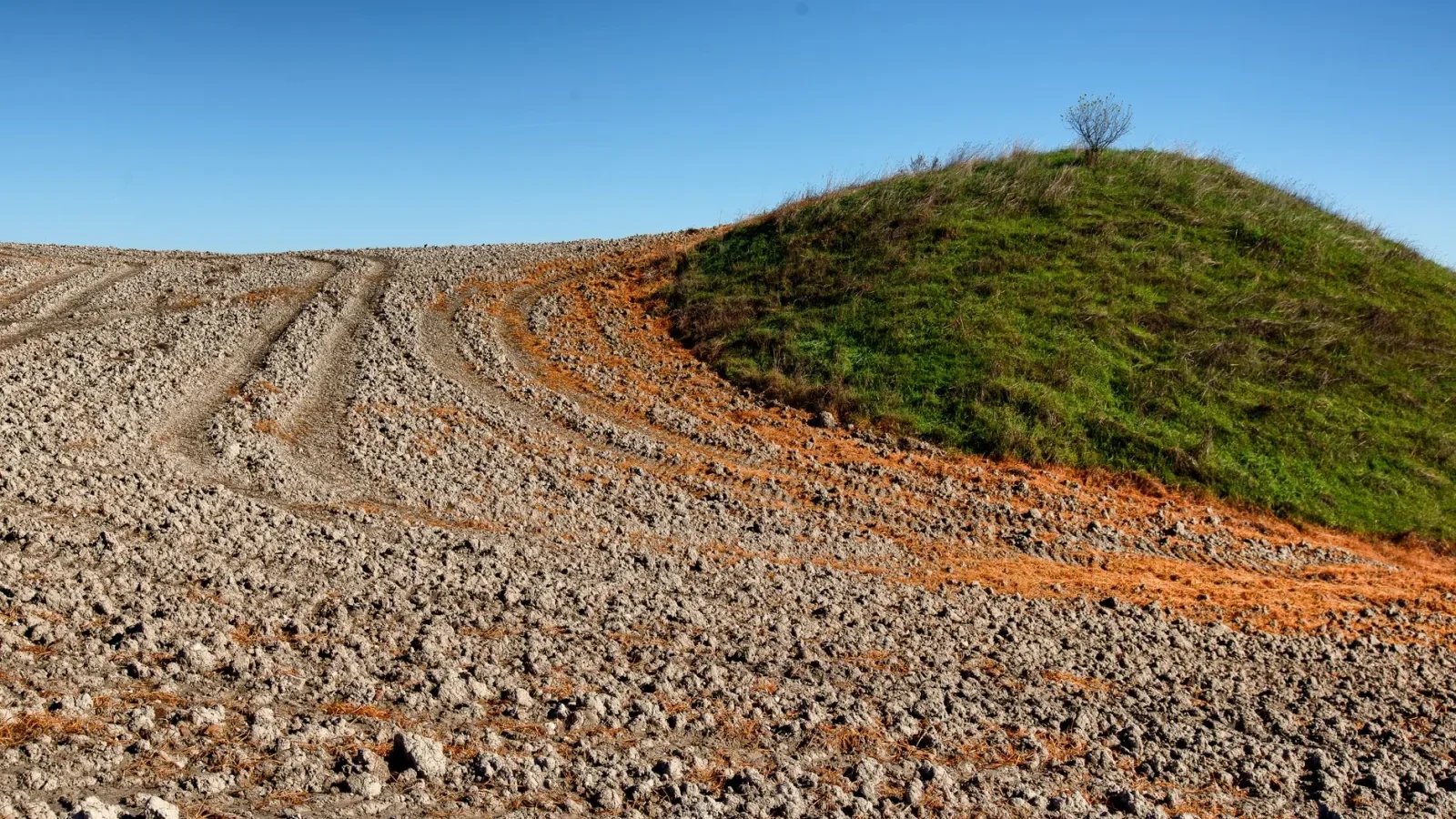
Drive through septic country long enough and you will spot them: long, grassy hills sitting oddly in a flat yard, too neat to be natural. That hill is almost always a mound drain field, and it sits there for a reason the ground underneath could not meet on its own.
Most homes get a conventional field buried out of sight. Some lots cannot support one, and a raised mound is what makes them buildable at all. Here is how the two differ, when each is required, and how the daily care splits apart.
Key Takeaways
- A conventional drain field buries perforated pipe in gravel trenches and lets effluent flow down through the natural soil by gravity.
- A mound drain field builds a raised bed of sand fill above the ground and pumps effluent up into it, used when the native soil cannot treat waste safely.
- The deciding factor in the mound vs conventional drain field choice is your soil: a high water table, shallow bedrock, or soil that drains too fast or too slow forces a mound.
- A mound costs more to build ($10,000 to $20,000 is common) and adds a pump you must maintain, while a conventional field often runs $3,000 to $10,000 with no moving parts.
- Both fields hate compaction and extra water, but a mound needs stricter grass cover, freeze protection, and pump care to last.
What a Conventional Drain Field Is
The conventional drain field is the design most septic owners picture, even if they have never seen theirs. After the tank settles out solids, the liquid effluent flows into a network of perforated pipes laid in gravel-filled trenches a foot or two below the surface. From there it seeps down and out into the native soil.
The soil does the real work. As effluent moves down through several feet of unsaturated earth, bacteria and natural filtering strip out the harmful stuff before it ever reaches groundwater. That is why a conventional field only works where you have enough good soil beneath the trenches to finish the job. If you want the full picture of how this piece fits the rest of the system, our septic drain field guide walks through it start to finish.
The big advantage here is simplicity. A conventional gravity field has no pump, no electricity, and nothing to break. Effluent moves downhill on its own, which is exactly why it is cheaper to build and cheaper to live with. The names get used loosely, so if the term itself trips you up, our explainer on what a leach field is clears up the vocabulary.
What a Mound Drain Field Is
A mound drain field does the same job as a conventional one, but it brings its own soil to the party. Instead of relying on the ground below, a crew builds a raised bed of clean sand fill on top of the natural surface, then lays the gravel and distribution pipe inside that sand. Grass and topsoil cover the whole thing, which is why it reads as a low grassy hill.
Because the treatment area now sits above the tank, effluent cannot flow uphill on its own. A mound system adds a separate pump chamber that collects effluent and doses it up into the mound in timed bursts. That single change ripples through everything: the mound needs electricity, it has a pump and floats and an alarm, and it depends on parts that a conventional field simply does not have.
The payoff is that a mound creates the treatment layer the site was missing. Where there is only a foot or two of good soil over rock or a seasonal water table, the sand fill supplies the extra depth that safe treatment requires. On a friend’s lakeside lot, the mound was the only design the health department would permit, and without it the parcel could not have been built on at all.
Why Soil and Water Decide Which You Get
You do not really choose between a mound and a conventional field. Your soil chooses for you, and a percolation test plus a soil profile pit is how the designer reads that decision. The question they are answering is simple: is there enough good, unsaturated soil under this spot to treat effluent safely?
The perc test and separation distance
A perc test measures how fast water drains through your soil, and a backhoe pit shows what the soil layers look like going down. Codes then require a minimum vertical separation, often around three to four feet of suitable soil, between the bottom of the trenches and any limiting layer. When that separation exists, a conventional field is fair game.
The three conditions that force a mound
A mound gets required when the natural ground falls short in one of a few predictable ways.
- A high water table. If groundwater or a seasonal wet layer sits close to the surface, there is not enough dry soil below a normal trench to treat effluent before it hits the water table.
- Shallow soil over bedrock or hardpan. Only a foot or two of soil over rock leaves nowhere for a conventional field to send the liquid, so the mound adds the missing depth on top.
- Soil that drains too fast or too slow. Coarse sand or gravel lets effluent race through before it is treated, while heavy clay barely drains at all. Both extremes can push a site toward a mound or another engineered design.
Soil is the single biggest driver of which system your lot can hold, and it is worth understanding before you buy land or price a repair. Our deeper look at how soil type shapes a drain field explains why two lots on the same road can need completely different systems.

Conventional vs Mound Drain Field, Side by Side
Lined up next to each other, the two designs rarely win on the same row. The mound buys you a buildable lot and pays for it in cost and upkeep. The table below shows the trade at a glance.
| Feature | Conventional field | Mound field |
|---|---|---|
| How it works | Effluent flows by gravity into buried trenches | Effluent is pumped up into a raised sand bed |
| Best soil | Deep, well-draining native soil | Shallow, wet, or fast-draining soil |
| Appearance | Flat, hidden below the lawn | Visible grassy hill above grade |
| Moving parts | None | Dose pump, floats, and alarm |
| Electricity | Not needed | Required to run the pump |
| Typical build cost | $3,000 to $10,000 | $10,000 to $20,000 or more |
| Footprint | Smaller | Larger, needs open space |
| Main upkeep | Keep traffic and water off it | Same, plus pump care and grass cover |
| Lifespan with care | 20 to 30 years | 15 to 25 years |
The row people underestimate is moving parts. A conventional field can sit quietly for decades with nothing to fail. A mound depends on a pump, and a pump is a device that will eventually wear out and need replacing, usually every 7 to 15 years.
How the Cost Compares
Price is where the two designs separate most clearly. A conventional field is cheaper on nearly every line: less material, no pump chamber, no electrical work, and a smaller excavation. That is why installers reach for it whenever the soil allows.
A mound costs more because it is a bigger project. You are buying and hauling in truckloads of clean sand fill, building the bed by hand to spec, and adding a pump chamber with its own electrical hookup and alarm. Those extras commonly push a mound to double or more what a comparable gravity field would run. The pump also adds a small forever cost: electricity to run it and a replacement every decade or so.
None of that makes a mound a bad deal. On a lot that cannot legally hold a conventional field, the mound is not the expensive option, it is the only option, and it is what keeps the property usable.
How Care Differs Between the Two
Both fields share the golden rules of drain field care: keep vehicles off, keep extra water away, and never build or pave over them. Past that shared baseline, a mound asks for a few things a conventional field does not.
Caring for a conventional field
- Keep cars, trucks, and heavy equipment off the field so the soil never compacts and crushes the pipes.
- Route roof runoff, sump lines, and surface water away from it, since a soggy field cannot absorb effluent.
- Grow grass over it and skip trees and shrubs, whose roots hunt for the water in the pipes.
- Spread out laundry and heavy water use so you never flood the trenches all at once.
Caring for a mound field
- Everything on the conventional list still applies, only more strictly, because a mound has less reserve capacity to absorb a mistake.
- Keep a healthy, mowed grass cover on the whole mound. That turf holds the sand in place and stops the sides from eroding in heavy rain.
- Watch the pump and the alarm. If the alarm sounds, effluent is backing up in the pump chamber, and that is your cue to call for service before it surfaces.
- Protect it from freezing in cold climates by leaving the grass a little longer going into winter and never scraping snow off the mound, since that snow blanket is insulation.
- Guard your water use. A mound doses effluent in measured bursts, so a sudden flood of water from a leaky fixture or a house full of guests can overwhelm it faster than a gravity field.
The pump is the piece owners forget until it fails. A working mound is quiet, so it is easy to assume all is well right up until the alarm goes off. Keeping surface water off both designs matters too, and our walk-through on how to divert rainwater from a drain field is doubly important for a mound that erodes when it stays wet.
Tip: Know your pump before it quits
If you own a mound, find the pump chamber lid and the alarm panel today, while nothing is wrong. Note the pump model and the date it was installed, and test that the alarm actually beeps by pressing its test button. On the mound I help a neighbor watch, that two-minute check caught a dead alarm float a full year before the pump itself failed, which turned a potential backup into a scheduled $400 fix instead of an emergency call.

Frequently Asked Questions
Is a mound septic system better than a conventional one?
Neither is better in a vacuum, because they solve different problems. A conventional field is simpler, cheaper, and has no pump to fail, so it wins anywhere the soil can support it. A mound is only better in the sense that it works on sites where a conventional field is not allowed, such as lots with a high water table or shallow bedrock. If your soil qualifies for a conventional field, that is almost always the smarter and cheaper build.
Why do I have a raised drain field instead of a buried one?
A raised mound field means the natural soil on your lot could not treat effluent safely on its own. The most common reasons are groundwater sitting too close to the surface, bedrock or hardpan just a foot or two down, or soil that drains too fast or too slow. The mound brings in clean sand fill to create the treatment layer the ground was missing. In short, the hill in your yard is there because the site required it, not because someone chose the pricier option.
How long does a mound septic field last?
With good care, a mound field commonly lasts 15 to 25 years, a bit less than a well-kept conventional field. The pump inside the system is the shorter-lived part and usually needs replacing every 7 to 15 years, which is a routine repair rather than a full failure. What shortens a mound’s life fastest is the same list that hurts any field: compaction from traffic, chronic overloading with water, and letting the grass cover wash away. Steady water use and a protected mound keep it near the top of that range.
Can I convert a mound back to a conventional drain field?
Almost never, because the reason you have a mound is the soil itself, and that does not change. If the ground had enough good soil for a conventional field, you would have been given one in the first place. The only situations that shift the answer are major site changes, like a dropping water table over many years, and even then a soil scientist and the health department would need to re-evaluate the lot. For nearly every owner, the mound is the permanent design for that parcel.
Can I drive or park on either type of drain field?
No, and this rule is even stricter for a mound. Any vehicle compacts the soil and can crush the pipes below a conventional field, which is why you keep cars, trailers, and heavy equipment off it. On a mound, the added weight also damages the sand structure and the pressurized pipe inside the bed, and it can start erosion on the slopes. Treat both fields as no-drive zones, and give a mound extra room since its edges are more fragile than a flat field.
Conclusion
The mound vs conventional drain field question is really a question about your dirt. Where the soil runs deep and drains well, a conventional gravity field is the simpler, cheaper, longer-lasting choice with nothing to break. Where the soil is shallow, wet, or too coarse, a raised mound supplies the treatment the ground cannot, at a higher price and with a pump to look after. Learn which one sits in your yard, respect the care it asks for, and it will quietly do its job for decades. For more on protecting whatever field you have, browse our other drain field care articles and lean on guidance from the EPA septic program and the University of Minnesota onsite sewage program when you need a second opinion.