
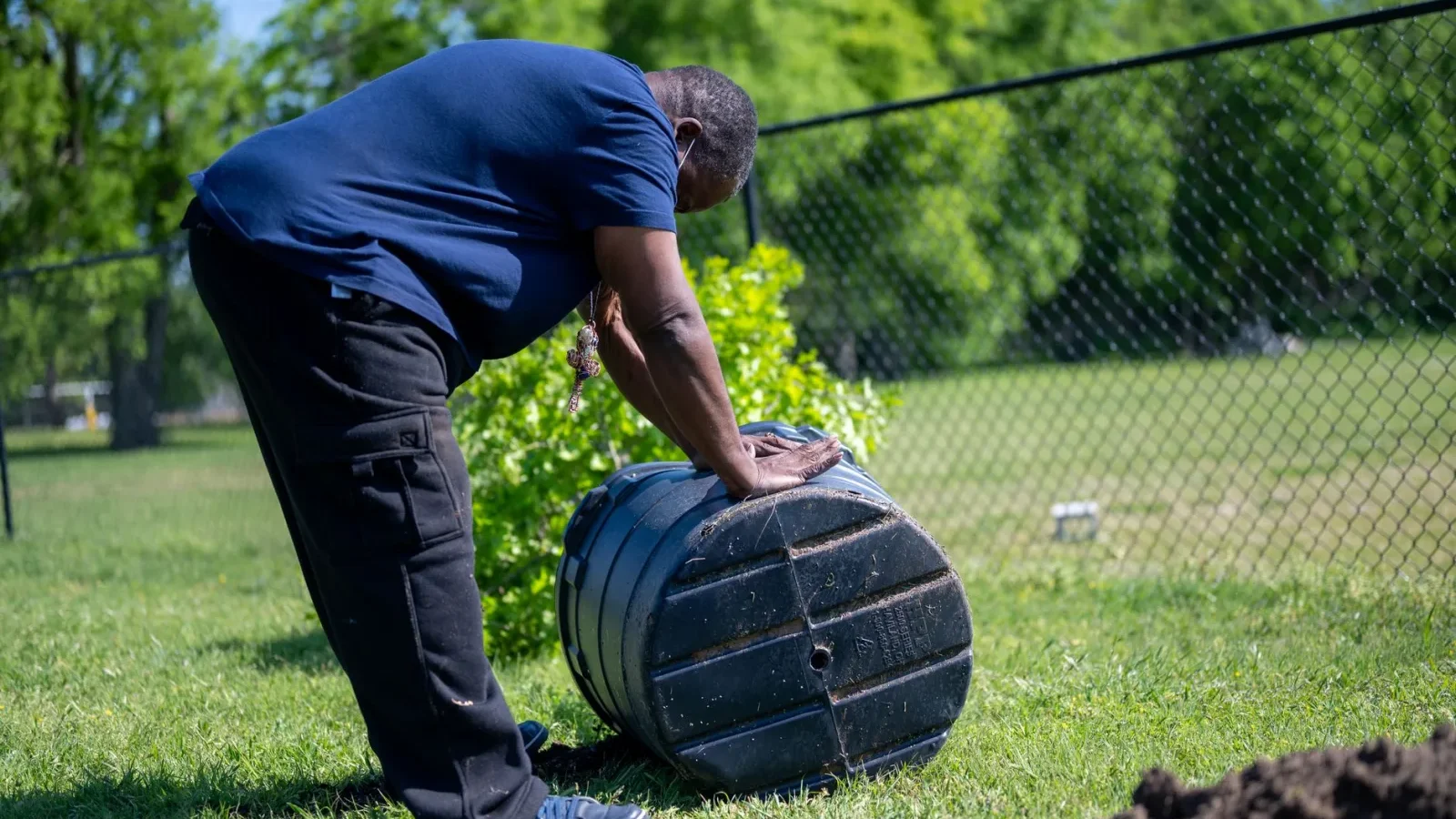
A neighbor called me last spring after a soggy patch near her tank turned into a small sinkhole overnight. Her concrete tank had split at the seam, and the three quotes she gathered ran from $3,800 to $8,900 for what sounded like the same job. That kind of spread is normal, and it rattles people.
Replacing just the septic tank is a defined piece of work with about a dozen line items. Once you see them broken out, the price stops feeling like a number pulled from thin air. Here is exactly where the money goes.
Key Takeaways
- Replacing only the tank (not the drain field) typically runs $3,000 to $9,500 installed, with most homeowners landing near $5,000 to $7,000.
- The tank itself is often the smallest line item. Excavation, removing the old tank, and permits usually add up to more than the new tank costs.
- Material and size matter: a 1,000-gallon plastic tank may cost $900 to $1,500, while concrete and larger sizes push the total higher.
- Access, depth, and local permit rules move the final price more than any other factor.
- Fixing the real cause (a cracked baffle, roots, or a long-overdue pumping) sometimes avoids a full replacement altogether.
What “Just the Tank” Replacement Covers
This breakdown is for swapping out the tank alone, while the drain field stays in place and keeps working. That is a very different project from replacing a whole system, and the price gap is large. A tank-only job leaves the buried field lines untouched, so you skip the soil testing, redesign, and heavy field excavation that make full replacements so expensive.
Before you commit to a new tank, it is worth confirming that the tank is truly the failed part. A soggy yard often points at the field, not the tank. Our look at when to repair versus replace a septic component can help you decide, and if the field is also involved, compare the numbers in our guide to new system versus drain field replacement costs before you sign anything.
A tank gets replaced for a handful of reasons: a cracked or collapsed concrete tank, a rusted-through steel tank (these were common before the 1980s), a tank that has heaved or shifted, or one so old that repair no longer makes sense. The EPA’s SepticSmart homeowner resources are a good neutral place to read about when a tank has genuinely reached the end of its life.
The Line-Item Cost Breakdown
Here is the whole job priced out piece by piece. Every number is a typical US range for a straightforward residential swap. Your soil, depth, and local labor rates will nudge each line up or down.
| Line item | Typical range | What it covers |
|---|---|---|
| Permit and paperwork | $250-$600 | County permit, and sometimes a quick site review |
| Pump and empty old tank | $300-$600 | Required before the old tank can be removed safely |
| Excavation and access | $1,200-$3,000 | Digging out the tank; deeper or tight sites cost more |
| Remove and haul old tank | $500-$1,500 | Lifting, crushing, and disposal of the old unit |
| New tank (materials) | $900-$2,000 | The tank itself, by size and material |
| Delivery and set | $200-$500 | Trucking and craning the new tank into the hole |
| Plumbing, baffles, risers | $450-$1,200 | Inlet and outlet connections, tees, and access risers |
| Backfill, grading, restoration | $400-$1,500 | Filling in, compacting, and reseeding the disturbed area |
| Inspection or re-inspection | $0-$250 | Often bundled in the permit; some counties charge separately |
Add the middles of those ranges and you land around $6,000, which lines up with what most homeowners actually pay for a routine swap. A shallow tank in an open yard can come in under $4,000. A deep tank under a driveway with a high water table can climb past $9,000.
Why the tank is rarely the biggest number
People assume the tank is the main expense, then get surprised. On most jobs the excavation and the removal of the old tank together cost two to three times what the new tank does. You are paying for an excavator, an operator, a haul truck, and sometimes a crane, all on site for the better part of a day.
That is also why a second tank swap on the same property, if it ever happened, would not be much cheaper. The labor and equipment are the price, not the plastic or concrete box itself.
New Tank Prices by Material and Size
The tank you choose changes both the material line and the set line, since concrete is heavy enough to need a boom truck. Plastic and fiberglass are lighter and simpler to place, but they can cost more per gallon. This table shows the tank price on its own, before install.
| Tank type and size | Material price | Notes |
|---|---|---|
| 1,000 gal plastic (poly) | $900-$1,500 | Light, quick to set, good for tight access |
| 1,000 gal fiberglass | $1,200-$2,100 | Strong and rustproof, higher material cost |
| 1,000 gal concrete | $700-$1,800 | Cheap material, but crane and freight add up |
| 1,250-1,500 gal concrete | $1,200-$2,400 | Common for 4-plus bedroom homes |
Match the size to your house, not to the old tank. Codes are stricter now than they were decades ago, so a three-bedroom home that once had an 800-gallon tank may be required to move up to 1,000 or 1,250 gallons on replacement. Your installer pulls the required size from the permit, which is one more reason the permit step is not optional.

What Shifts the Total Up or Down
Two identical tanks on two properties can differ by thousands of dollars. These are the factors that do the moving, roughly in order of impact:
- Access. An open backyard is cheap to dig. A tank under a deck, patio, or driveway means demolition and rebuild, which can add $1,000 to $4,000.
- Depth and water table. A deep tank, or a hole that fills with groundwater, needs more digging, shoring, or pumping while the crew works.
- Material and size. Concrete versus plastic, and 1,000 versus 1,500 gallons, both change the material and handling lines.
- Region and labor rates. The same job costs more near coastal cities than in rural counties, sometimes by 40 percent or more.
- Permits and soil review. Some counties want only a permit; others require an engineer or a fresh site evaluation on any replacement.
- Restoration. Reseeding a lawn is cheap. Replacing a driveway apron, mature landscaping, or a concrete pad is not.
- Emergency versus planned. A collapsed tank on a holiday weekend costs more than a job you scheduled a month out.
Access is the one that shocks people most. I have seen a $4,500 job turn into a $7,000 job purely because a decade-old patio was sitting on top of the tank lid.
Ways to Keep the Replacement Cost Reasonable
You cannot make excavation free, but you can avoid paying more than the job is worth. A few habits keep the total honest:
- Get three itemized bids. A single price tells you nothing. Line-item quotes let you compare apples to apples and spot padding.
- Plan it before it fails. An emergency call strips away your bargaining room and your time to shop around.
- Ask about abandoning the old tank in place. Where local code allows crushing and filling the old tank rather than hauling it, you can save $500 or more.
- Add risers while the hole is open. Bringing access lids to the surface costs little now and saves digging at every future pump-out.
- Bundle the required pump-out with the same contractor rather than paying two mobilization fees.
- Confirm exactly what the permit and price include, especially inspection, restoration, and haul-away, so nothing shows up as a surprise later.
For the wider picture of what a septic system costs to own and maintain over the years, our complete guide to septic system costs puts tank replacement in context next to pumping, repairs, and inspections.
Tip: Make every quote list the old-tank removal separately
The single biggest source of surprise charges is what happens to the old tank. Ask each contractor to write out, as its own line, whether they haul it away, crush and fill it, or leave it, and what that costs. If one bid is oddly low, it is often because that step was quietly left out and will reappear as a change order once the excavator is already in your yard.

Frequently Asked Questions
How much does it cost to replace just a septic tank?
Replacing the tank alone, with the drain field left in place, usually runs $3,000 to $9,500 installed. Most homeowners pay somewhere around $5,000 to $7,000 for a standard job. A shallow tank in an open yard sits at the low end, while a deep tank under a driveway with groundwater in the hole pushes toward the high end.
Is it cheaper to repair or replace a septic tank?
Repairing a specific part, like a cracked baffle or a failed inlet tee, can cost a few hundred dollars and is far cheaper than a full swap. Replacement makes sense when the tank body itself has cracked, collapsed, or rusted through, since patching structural damage rarely lasts. A licensed inspector can tell you which situation you are in before you spend on the wrong fix.
Does replacing the tank mean replacing the drain field too?
Not usually. The tank and the drain field are separate parts, and a tank can fail while the field is still healthy. As long as the field passes inspection, you can replace only the tank. If the field is also failing, the project and the cost grow substantially, so it is worth confirming the field’s condition first.
How long does a septic tank replacement take?
The physical work is often finished in one day, sometimes two if access is difficult or a driveway has to be removed and rebuilt. The bigger delay is usually the permit, which can take a few days to a few weeks depending on your county. Scheduling ahead of a failure lets you clear that paperwork calmly instead of under pressure.
Can I replace a septic tank myself?
In almost every US county, no. Tank replacement requires a permit and usually a licensed installer, and an unpermitted job can block a future home sale or void your inspection record. The work also involves heavy equipment, deep excavation, and confined-space hazards. This is one project to hire out, both for safety and to keep your paperwork clean.
Conclusion
A tank replacement feels like a scary, open-ended number until you break it into parts. Once you know the permit, the pump-out, the excavation, the new tank, and the backfill each have their own price, a quote is easy to read and easy to question. Aim for three itemized bids, confirm the field is healthy first, and treat any missing line (especially old-tank removal) as a question, not a bargain. For more plain-English pricing on every part of your system, browse the rest of our septic cost and budgeting articles and go into your next quote already knowing the numbers.